
OpinionEdmond W. Davis | February 13, 2025
DEI, originally coined as Diversity, Equity and Inclusion, has a new meaning for Black Americans in the second age of Trump called the Declaration of Economic Independence.
In 2020, after the murder of George Floyd, corporate America temporarily pledged billions of dollars to racial equity initiatives, reinforcing DEI policies and vowing to support Black-owned businesses, among other things. The momentum felt historic.
However, five years later, the tide has shifted. Many of those same corporations have quietly scaled back or eliminated their DEI commitments — yes, the honeymoon is over. With the resurgence of a second Trump-era political landscape, it’s clear these efforts never were a marriage — only a five-year engagement, miles away from a romantic comedy.
Edmond W. Davis
Now, according to a Pew Research study, there are 48.3 million Black Americans (14.4% of the U.S.), armed with a collective GDP of $1.6 trillion, who are responding with a Declaration of Economic Independence. This is not a play on words or a reactionary measure; it is a strategic realignment — a return to the economic self-sufficiency that once sustained Black communities nearly 15 years after Colonial slavery, a monumental human feat that’s grossly neglected.
For Black History Month 2025, I call on all African Americans to buy, invest and support Black-owned businesses, products and services exclusively. This movement is not about exclusion; rather, it is a deliberate act of self-determination and financial empowerment. This movement is not just for African Americans. Asian Americans, Latino-Americans, Native Americans, Arab Americans, Caucasians/European Americans, LGBTQ individuals, veterans, women, the disabled and other communities are encouraged to support Black-owned establishments, purchase their products and invest in their initiatives — just as Black consumers have supported businesses of all backgrounds for generations.
In the wake of 2020’s social justice protests, corporations such as Meta, McDonald’s and Target loudly proclaimed their commitment to DEI. But by 2023 and 2024, the corporate backpedaling was swift and undeniable.
“None of these corporations are low on funds, but they are low on morale.”
Many Black-owned products were removed from major retail shelves while funding for Black entrepreneurs dwindled. Meanwhile, DEI resources remained available for other minority groups, including white women, veterans, LGBTQ communities, the disabled and Native Americans. None of these corporations are low on funds, but they are low on morale. These corporate gatekeepers’ hearts were not authentically interested in the independent economic equity of Black entrepreneurs.
This shift is not a coincidence. The political climate has turned increasingly hostile toward DEI policies, with new presidential executive orders aimed at dismantling federal DEI programs. This corporate retreat proves one hard truth: Black economic advancement cannot rely on corporate goodwill.
It must be built, sustained and protected by the community itself, like the various Black Wall Streets in the late 19th century to the mid-20th century.
Historical marker on downtown Durham’s Parrish Street. (Photo: Jonathan Lee / Discover Durham)
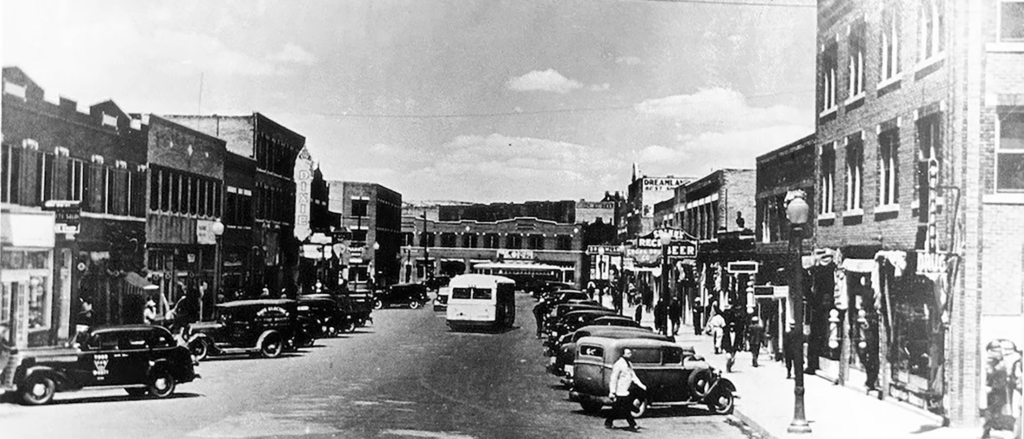
Economic self-sufficiency is woven into the fabric of Black American history. From the 1880s to the 1960s, Black communities built nearly 100 self-sustaining Black economic hubs — often referred to as Black Wall Streets.
While Tulsa’s Greenwood District is arguably the most famous, vibrant hubs of Black prosperity also flourished in Hayti and Durham, N.C.; Sweet Auburn in Atlanta; New York City; Elaine, Ark.; Chicago; Little Rock’s West 9th Street; Jackson Ward, Richmond, Va.; Farish Street, Jackson, Miss.; and beyond.
These communities thrived despite segregation, creating generational wealth, financial institutions and businesses that served Black families and beyond. However, many of these enclaves were systematically dismantled — some through violent massacres, others through policies like redlining, urban renewal and economic disenfranchisement. These late 19th-century and early 20th-century Wakandas were the epicenters of safety, commerce, economic vitality and societal health free of racist Jim Crow practices.
“Black America must assert its right to economic sovereignty unapologetically.”
History shows when we invest in ourselves, we thrive. Black communities must now reclaim that legacy of economic resilience and prosperity. Just as Chinatowns, Little Italys and Jewish business districts have flourished through community reinvestment, Black America must assert its right to economic sovereignty unapologetically.
For Black History Month 2025, I challenge all African Americans to engage in a month-long economic boycott of corporations that have abandoned DEI commitments. Instead, let’s redirect our $1.6 trillion buying power into Black-owned businesses, e-commerce platforms, markets and restaurants. Yes, spend that extra dollar or walk that extra block.
This is not about exclusion or retaliation; it is about economic love, community growth and self-preservation. The strategy mirrors the Montgomery Bus Boycott of 1955-1956, where Black Americans sacrificed convenience for the sake of justice. That movement was difficult, but it sent an undeniable message: Economic power fuels systemic change.
By shifting our spending habits, we demand recognition, fairness and economic justice. This is not a temporary boycott, but a pivot to a new way of life. As those corporations demonstrated a change of course, so can we. Additionally, others are asked to stand in solidarity with Black America.
Support from Latinos, Native Americans, Asians, LGBTQ, veterans, the disabled and women is welcomed — this is an equal-opportunity public pivot.
“Economic freedom is not a civil right; it’s a human right.”
Beginning in February 2025 and continuing until economic equity is as common as a stop sign at a two-way intersection. Economic freedom is not a civil right; it’s a human right, and it must be taken — because it will not be given. It will be taken when African Americans become fed up with the corporate schizophrenia witnessed today.
The rollback of DEI initiatives proves corporations will not voluntarily invest in Black communities. True economic equity comes from ownership, investment and collective action. Martin Luther King Jr. understood this, shifting his focus in his final years from civil rights to the economic justice of human rights. His unfinished vision was one where Black Americans controlled their financial destiny, not their oppressors.
Today, we are reviving that vision with our Declaration of Economic Independence.
Let’s be clear: This is not a call for separation; it is a call for support. Just as Black consumers have fueled the success of businesses owned by Asians, Latinos, Caucasians, LGBTQ individuals, women, Native Americans, Africans, Indians, Arab Americans and other communities, we now invite those same groups to stand with us in this economic movement.
Black businesses offer world-class products, services and innovations that serve all communities. From fashion to food, technology to entertainment, music, health care to finance, Black entrepreneurs continue to lead. Supporting these businesses strengthens the entire economy. Target, McDonald’s, Walmart and other companies intentionally use songs and musical elements created by African Americans to reel in America’s largest consumer base (African Americans), now these same companies pull back on policies designed to support African Americans.
“Economic justice is not a Black issue; it is an American issue.”
Economic justice is not a Black issue; it is an American issue.
Amid Black History Month 2025, this initiative calls upon African Americans — and our allies — to rethink our collective economic power. Let us reflect on the legacy of our forebears, who built thriving businesses despite segregation, lynchings, discrimination and destruction.
The Declaration of Economic Independence is not just a one-month pledge; it is the foundation for a lifetime of economic self-determination and fiscal equity.
This new DEI isn’t just a new term or fad but a realistic goal that once was experienced. The new DEI and the old DEI have one commonality: through collective effort, we can reshape our financial future and build a legacy of economic empowerment for generations to come.
Edmond W. Davis is a journalist, social historian, Tuskegee Airmen global scholar and emotional intelligence expert.
Related articles:
Super Bowl halftime DEI show: The Greatest Protest on Turf | Opinion by Edmond Davis
Beauty from ashes: How catastrophe shaped the Bible | Opinion by Alan Bean
The sacredness of DEI | Opinion by Ginny Brown Daniel

— A BNG interview series on the 2024 election and the Church
News
News
Opinion
News
© 2025 Baptist News Global. All rights reserved.
Want to share a story? We hope you will! Read our republishing, terms of use and privacy policies here.
About The Author









More Stories
GTA, Police probe alleged kidnapping, extortion of visiting black Americans – Modern Ghana
US park service to offer free entry on Trump’s birthday but revokes it for MLK Day and Juneteenth – The Guardian
After Trump Removes Major Black Holidays From National Park Calendar for His Birthday, Folks Are Left Furious – The Root