

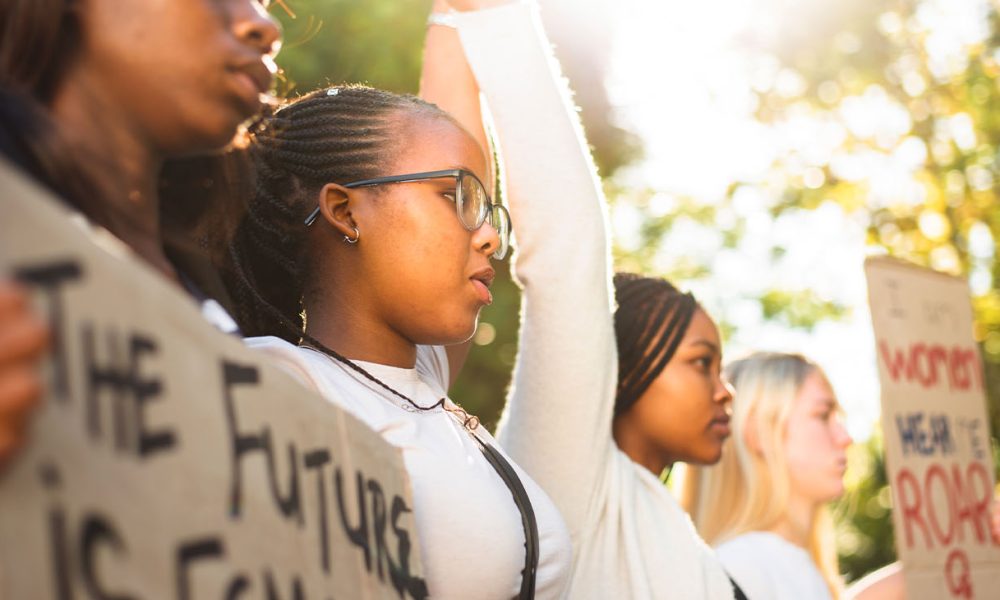
BLACKPRESSUSA NEWSWIRE — More than 500 Black feminists will convene in New Orleans from June 5 through 7 for what organizers are calling the largest Black feminist gathering in the United States.
Published
on
By
By Stacy M. Brown
Black Press USA Senior National Correspondent
More than 500 Black feminists will convene in New Orleans from June 5 through 7 for what organizers are calling the largest Black feminist gathering in the United States. The event, led by the organization Black Feminist Future, is headlined by activist and scholar Angela Y. Davis. Paris Hatcher, executive director of Black Feminist Future, joined Black Press USA’s Let It Be Known to outline the mission and urgency behind the gathering, titled “Get Free.” “This is not just a conference to dress up and have a good time,” Hatcher said. “We’re building power to address the conditions that are putting our lives at risk—whether that’s policing, reproductive injustice, or economic inequality.” Hatcher pointed to issues such as rising evictions among Black families, the rollback of bodily autonomy laws, and the high cost of living as key drivers of the event’s agenda. “Our communities are facing premature death,” she said.
Workshops and plenaries will focus on direct action, policy advocacy, and practical organizing skills. Attendees will participate in training sessions that include how to resist evictions, organize around immigration enforcement, and disrupt systemic policies contributing to poverty and incarceration. “This is about fighting back,” Hatcher said. “We’re not conceding anything.” Hatcher addressed the persistent misconceptions about Black feminism, including the idea that it is a movement against men or families. “Black feminism is not a rejection of men,” she said. “It’s a rejection of patriarchy. Black men must be part of this struggle because patriarchy harms them too.” She also responded to claims that organizing around Black women’s issues weakens broader coalitions. “We don’t live single-issue lives,” Hatcher said. “Our blueprint is one that lifts all Black people.”
The conference will not be streamed virtually, but recaps and updates will be posted daily on Black Feminist Future’s YouTube channel and Instagram account. The event includes performances by Tank and the Bangas and honors longtime activists including Billy Avery, Erica Huggins, and Alexis Pauline Gumbs. When asked how Black feminism helps families, Hatcher said the real threat to family stability is systemic oppression. “If we want to talk about strong Black families, we have to talk about mass incarceration, the income gap, and the systems that tear our families apart,” Hatcher said. “Black feminism gives us the tools to build and sustain healthy families—not just survive but thrive.”
Trump Got Checked on Tariffs
Hoover’s Commutation Divides Chicago as State Sentence Remains
A Little About Me: I’m the co-author of Blind Faith: The Miraculous Journey of Lula Hardaway and her son, Stevie Wonder (Simon & Schuster) and Michael Jackson: The Man Behind The Mask, An Insider’s Account of the King of Pop (Select Books Publishing, Inc.) My work can often be found in the Washington Informer, Baltimore Times, Philadelphia Tribune, Pocono Record, the New York Post, and Black Press USA.
Trump Got Checked on Tariffs
Hoover’s Commutation Divides Chicago as State Sentence Remains
WATCH: Five Years After George Floyd: Full Panel Discussion | Tracey’s Keepin’ It Real | Live Podcast Event
Harvard Reaches Historic Settlement Over Earliest Known Photographs of Enslaved Americans
True Unemployment Rate Soars Past 24% — Black Workers Hit Hardest
PRESS ROOM: Black Leaders Detroit Launches 1,600-mile Ride for Equity to Raise Awareness, Funding for Entrepreneurs of African Descent
BLACKPRESSUSA NEWSWIRE — The courts essentially deemed the president’s tariff declaration invalid. Democratic Texas Congresswoman Jasmine Crockett says President Trump “has a lot of emergencies in his mind for sure.”
Published
on
By
By April Ryan
The Trump White House vows to appeal the three-judge panel of the United States Court of International Trade’s ruling that the proposed presidential tariffs exceed his legal authority. This ruling means neither President Trump nor his administration can arbitrarily invoke tariffs under the International Emergency Economic Powers Act of 1977. The three judges appointed by former Presidents Reagan, Obama, and Trump unanimously made the decision. The courts essentially deemed the president’s tariff declaration invalid. Democratic Texas Congresswoman Jasmine Crockett says President Trump “has a lot of emergencies in his mind for sure.” However, Crockett emphasized that this nation is not in an emergency to declare tariffs. “That act declared we are under siege. We are not at war,” assured Crockett.
Congress, which typically holds the purse strings under the Constitution, regulates import commerce with foreign nations. Michigan Democratic Congresswoman Debbie Dingle believes “it’s a win for consumers. It will not immediately increase costs in stores, which is what I’m worried about. But what’s the next step?” At the White House podium this week, Press Secretary Karoline Leavitt said the courts should have no role here. There is a troubling and dangerous trend of unelected judges inserting themselves into the presidential decision-making process.”
However, the ruling temporarily alleviates growing concerns about the cost of imports, from food to cars and more. Thursday, Dingle told Black Press USA in Mackinac, Michigan, at the Detroit Regional Chamber of Congress Meeting, “Every industry needs certainty, and they’re all dealing with a lot of uncertainty. The autos don’t want to be a ping pong ball. They’re too trying to keep their heads down and figure it out. So what we need for the industry and other companies is certainty.” The Trump administration has already filed motions to change the decision. Meanwhile, Crockett, a lawyer turned politician, says she’s “excited that some branch of government put a check on the executor.”
BLACKPRESSUSA NEWSWIRE — Hoover was convicted of murder and running a criminal enterprise. Although some supporters describe him as a political prisoner, the legal and public safety concerns associated with his name remain substantial.
Published
on
By
By Stacy M. Brown
Black Press USA Senior National Correspondent
The federal sentence for Gangster Disciples founder Larry Hoover has been commuted, but he remains incarcerated under a 200-year state sentence in Illinois. The decision by Donald Trump to reduce Hoover’s federal time has reignited longstanding debates over his legacy and whether rehabilitation or continued punishment is warranted. The commutation drew immediate public attention after music executive Jay Prince and artist Chance the Rapper publicly praised Trump’s decision. “I’m glad that Larry Hoover is home,” said Chance the Rapper. “He was a political prisoner set up by the federal government. He created Chicago Votes, mobilized our people, and was targeted for that.”
But Hoover, the founder of the Gangster Disciples, is not home—not yet. Now in federal custody at the Florence Supermax in Colorado, Hoover was convicted of murder and running a criminal enterprise. Although some supporters describe him as a political prisoner, the legal and public safety concerns associated with his name remain substantial. “There is a divide in the Black community here,” said Chicago journalist Jason Palmer during an appearance on the Let It Be Known morning program. “Some view Hoover as someone who brought structure and leadership. Others remember the violence that came with his organization.” Palmer explained that while Hoover’s gang originally formed for protection, it grew into a criminal network responsible for extensive harm in Chicago. He also noted that Hoover continued to run his organization from state prison using coded messages passed through visitors, prompting his transfer to federal custody.
Illinois Gov. J.B. Pritzker, who is widely considered a potential 2028 presidential contender, has not issued a statement. Palmer suggested that silence is strategic. “Releasing Hoover would create enormous political consequences,” Palmer said. “The governor’s in a difficult spot—he either resists pressure from supporters or risks national backlash if he acts.” According to Palmer, Hoover’s federal commutation does not make him a free man. “The federal sentence may be commuted, but he still has a 200-year state sentence,” he said. “And Illinois officials have already made it clear they don’t want to house him in state facilities again. They prefer he remains in federal custody, just somewhere outside of Colorado.”
Palmer also raised concerns about what Hoover’s case could signal for others. “When R. Kelly was convicted federally, state prosecutors in Illinois and Minnesota dropped their charges. If a president can commute federal sentences based on public pressure or celebrity support, others like R. Kelly or Sean Combs could be next,” Palmer said. “Meanwhile, there are thousands of incarcerated people without fame or access to public platforms who will never get that consideration.” “There are people who are not here today because of the violence connected to these organizations,” Palmer said. “That has to be part of this conversation.”
Join us as we return to the city where it happened and speak with a voice from the heart of the community – Tracey Williams-Dillard, CEO/Publisher of the Minnesota Spokesman-Recorder.
Published
on
By
May 25, 2020. The world stopped and watched as a life was taken.
But what has happened since?
Join us as we return to the city where it happened and speak with a voice from the heart of the community – Tracey Williams-Dillard, CEO/Publisher of the Minnesota Spokesman-Recorder.
She shares reflections, insights, and the story of a community forever changed. What has a year truly meant, and where do we go from here?
This is more than just a date; it’s a moment in history. See what one leader in the Black press has to say about it.
Recorded live at UROC in Minneapolis, this powerful discussion features:
Panelists:
<ul>
<li>Medaria Arradondo – Former Minneapolis Police Chief</li>
<li>Nekima Levy Armstrong – Civil Rights Activist & Attorney</li>
<li>Dr. Yohuru Williams – Racial Justice Initiative,</li>
<li>UST Mary Moriarty – Hennepin County Attorney</li>
<li>Fireside Chat with Andre Locke – Father of Amir Locke</li>
</ul>
Special Guests:
<ul>
<li>Kennedy Pounds – Spoken Word Artist</li>
<li>Known MPLS – Youth Choir bringing purpose through song</li>
</ul>
This podcast episode looks at the past five years through the lens of grief, truth, and hope—and challenges us all to do more.
🔔 Subscribe to Tracey’s Keepin’ It Real wherever you get your podcasts or follow @mnspokesmanrecorder for more.
🔗 Visit https://spokesman-recorder.com for more coverage and stories from Minnesota’s trusted Black news source.
#GeorgeFloyd #BlackPress #SpokesmanRecorder #Minneapolis #BlackHistory
BLACKPRESSUSA NEWSWIRE — As part of the settlement, Harvard has agreed to fully relinquish the images to Lanier, who is advocating for their permanent display at the International African American Museum in Charleston
Published
on
By
By Stacy M. Brown
Black Press USA Senior National Correspondent
Harvard University will relinquish ownership of the earliest known photographs of enslaved people as part of a historic legal settlement announced Wednesday by nationally renowned civil rights attorney Ben Crump. The agreement resolves a 2019 lawsuit filed by Tamara Lanier, the great-great-great-granddaughter of an enslaved man known as “Papa Renty,” whose image, along with that of his daughter Delia and five others, was captured in 1850 to support racist scientific theories promoted by a Harvard professor. The 19th-century daguerreotypes, long held by Harvard’s Peabody Museum of Archaeology and Ethnology, were commissioned by Swiss-born biologist Louis Agassiz, a Harvard professor who used the images in a campaign to promote polygenism—the debunked and deeply racist theory that different races have separate origins and that Africans and African Americans are inferior to whites. The photographs were taken in South Carolina, where Renty and Delia were stripped and posed under duress.
“This is a day of reckoning 175 years in the making,” said Josh Koskoff, co-counsel on the case. “This is not just an unlikely personal victory for the Lanier family; it is also a win for the importance of truth and the power of history at a time when both values are under unprecedented assault.” As part of the settlement, Harvard has agreed to fully relinquish the images to Lanier, who is advocating for their permanent display at the International African American Museum in Charleston, South Carolina—the same state where the pictures were initially taken. A confidential financial agreement was also reached. “Since Black Americans were first brought to this country in chains, our pain and trauma have been exploited for capitalistic gain,” said Lanier. “Harvard played a role in the darkest chapter in American history. This is a small step in the right direction towards fully acknowledging that history and working to rectify it.”
The lawsuit accused Harvard of wrongfully seizing and profiting from the images, charging licensing fees for their use in books and promotional materials, and publicly dismissing Lanier’s well-documented genealogical claims. The Massachusetts Supreme Court ruled in her favor in 2022, stating that “Harvard’s present obligations cannot be divorced from its past abuses.” “Papa Renty was taken from his descendants and used to promote a lie – but today, he has finally been returned to the love and care of his family,” said Crump. “This historic settlement is a step forward in the pursuit of justice and a recognition of the pain caused by the dark history of exploiting enslaved people.” “They will be returning to their home state where this all began, and they will be placed in an institution that can celebrate their humanity,” Lanier said.
BLACKPRESSUSA NEWSWIRE — The numbers mark the third consecutive month that functional unemployment has surpassed 24%, according to LISEP, which defines functional unemployment as the combined total of those without jobs
Published
on
By
By Stacy M. Brown
Black Press USA Senior National Correspondent
Despite federal reports suggesting a stable labor market, new data from the Ludwig Institute for Shared Economic Prosperity (LISEP) reveals a far grimmer reality for American workers—particularly Black and Hispanic Americans. The institute’s April report on the True Rate of Unemployment (TRU) shows a functional unemployment rate of 24.3%, compared to the official Bureau of Labor Statistics (BLS) figure of 4.2%. The numbers mark the third consecutive month that functional unemployment has surpassed 24%, according to LISEP, which defines functional unemployment as the combined total of those without jobs, those unable to secure full-time employment, and those earning poverty-level wages—less than $20,000 per year adjusted for inflation. “We are facing a job market where nearly one in four workers are functionally unemployed, and current trends show little sign of improvement,” said LISEP Chair Gene Ludwig. “The harsh reality is that far too many Americans are still struggling to make ends meet.”
Racial and gender disparities remain wide. Black workers saw a 1.4 percentage point increase in their TRU to 26.7%, while White workers experienced a slight decrease to 23%. The rate for Hispanic workers climbed to 28.2%, maintaining the highest among reported groups. A persistent gender gap also emerged in the data: functional unemployment for men rose to 20%, while women—though showing a slight improvement—still face a significantly higher rate at 28.6%. Beyond labor force disparities, BLS statistics further indicate a disproportionate impact on Black Americans. The unemployment rate for Black men remains at 6.3%, more than double that of White men. Meanwhile, since September, approximately 181,000 Black women have dropped out of the labor force entirely, even as participation rates among women of other racial groups have increased. The origins of this exodus stretch back to 2020 when millions of working mothers—particularly women of color—left the workforce amid the collapse of childcare infrastructure during the COVID-19 pandemic. Many have yet to return due to ongoing issues with affordability and accessibility.
LISEP’s white paper, “Measuring Better,” outlines significant flaws in headline economic indicators such as GDP and BLS unemployment rates, labeling them misleading and outdated. Instead, LISEP advocates for measures that reflect the lived economic realities of most Americans—particularly those in working- and middle-class communities that have long been left behind by policy and prosperity. According to the paper, the methodology behind TRU includes only those working full-time and earning above poverty wages as “employed.” It excludes part-time workers who would prefer full-time employment and those earning less than $20,000 per year. This approach, LISEP argues, provides policymakers with a more accurate understanding of economic well-being and informs better decision-making for resource allocation. “The public would be well served by a commitment from economic policymakers to adopt a stable course of action, based on real-world metrics, that better serves the interests of working Americans,” Ludwig said.
BLACKPRESSUSA NEWSWIRE — Black Leaders Detroit, the organizing body, is dedicated to promoting equity through community action. “The 2025 Ride for Equity is our most ambitious initiative yet,” said Dwan Dandridge, co-founder and CEO of Black Leaders Detroit.
Published
on
By
Cross-country stops aim to spark conversations; $1 a week can make a difference
Detroit, MI — On May 31, cyclists from across the United States will gather at Black Wall Street in Tulsa, Okla., and embark on a 35-day cross-country bike ride, concluding at Wall Street in New York City on July 4th, pedaling more than 1,600 miles to raise awareness and start conversations about the need for equitable funding for entrepreneurs of African descent. The Ride for Equity is actively seeking both riders and donations. The public is encouraged to visit http://www.Ride4Equity.org to learn more, sign up to ride for one or all segments in person or their community, and pledge $1 a week to the cause. Black Leaders Detroit, the organizing body, is dedicated to promoting equity through community action. “The 2025 Ride for Equity is our most ambitious initiative yet,” said Dwan Dandridge, co-founder and CEO of Black Leaders Detroit. “In our current economic landscape, it’s more important than ever to join together. Whether you’re riding a single day or the entire distance, your participation can drive change by empowering others to act.”
Since 2020, Black Leaders Detroit has organized an annual 377-mile bike ride from Detroit to the Mackinac Policy Conference, raising awareness about the barriers entrepreneurs of African descent face in accessing capital. Last year, more than 250 participants joined the six-mile kickoff event, with 15 dedicated riders tackling one or more full days of the journey. The cross-country Ride for Equity aims to raise national awareness and inspire action to close the racial wealth gap. Throughout the ride, Black Leaders Detroit will host “Speak for Yourself” forums in key cities along the route. These forums are designed to spark vital community discussions that allow participants to share insights, learn from one another, and envision a future of unity and economic empowerment. “Our previous forums have proven instrumental in building bridges and fostering understanding across diverse communities,” said Dandridge. “With stops in Tulsa, Indianapolis, St. Louis, Columbus, Pittsburg, and New York, plus various smaller cities along the way, we’re working to get the country talking about how prioritizing unity can remedy many of our long-standing challenges as a country.”
HOW TO GET INVOLVED
Participation is open to cyclists worldwide. Whether you ride the full route, join a portion of the journey, or cycle independently in your city, you can be part of this powerful movement.
Participation Details:
Additional details about the 2025 Ride for Equity and links to register, volunteer, and give, can be found at ride4equity.org.
Cindy Kamerad
The Allen Lewis Agency
Phone: (586) 242-9417
Email: cindy@theallenlewisagency.com
Arianna Reamey
The Allen Lewis Agency
Phone: (248) 996-3888
Email: arianna@theallenlewisagency.com
NNPA NEWSWIRE — Location Last Seen: Ashley was last seen in the 20900 blk of Pinehurst St on January 2,…
NNPA NEWSWIRE — Last Seen Wearing: A black Nike hoodie, black jeans, and multicolored shoes.
NNPA NEWSWIRE — Location Last Seen: Dahe’lyn was last seen at his residence in the 8000 block of Greenridge Street…
MLK Bust Quietly Removed from Oval Office Under Trump
Target Boycotts and its Effect on Both Sides of the Black Dollar
Beyoncé, Tariffs, and the Battle for Black America
Target CEO Attempts Damage Control After Weeks of Silence and Mounting Backlash
Sounding The Alarm
Let It Be Known: “They Voted to Deport Us”
Copyright © 2025 National Newspaper Publishers Association. All rights reserved.
About The Author









More Stories
Black Community Urged to Stand with Immigrants against ICE Crackdown – Davis Vanguard
Hidden Catholic histories come alive in new Black and Native American films – Catholic News Agency
Does Hard Work Pay Off for Black Americans? – LEVEL Man