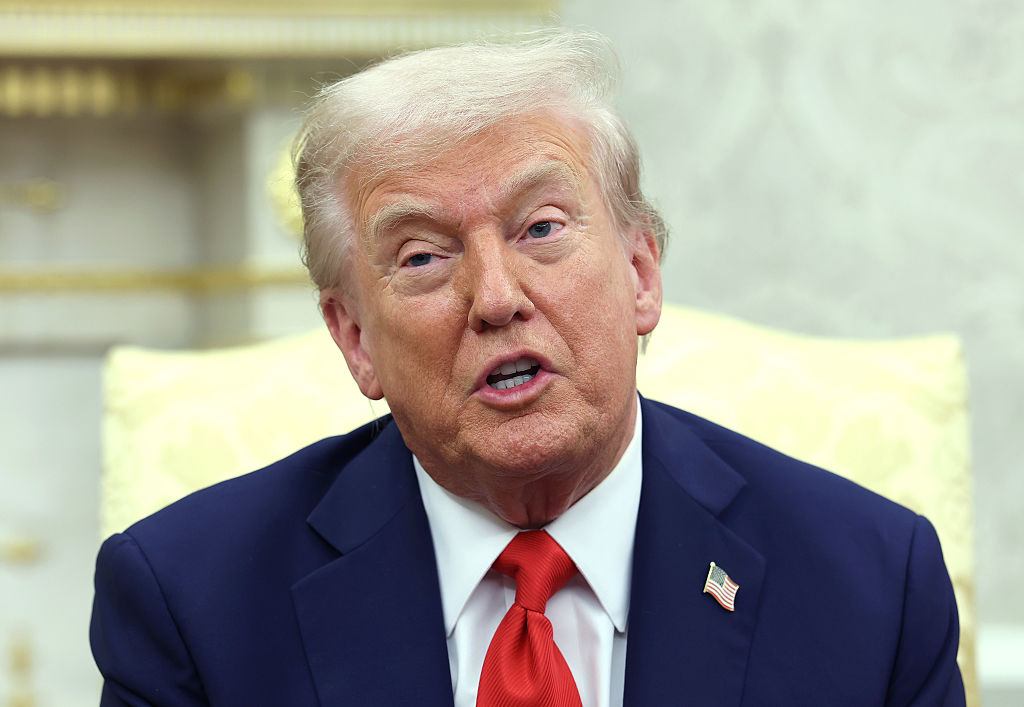
"Plenary Authority" gaffe aside, the Insurrection Act could expand Trump's abuse of power, inflicting maximum harm along the way.
A flurry of news reports over the last few days indicates the Trump administration may be moving closer to invoking the Insurrection Act. Responding to a federal judge denying Trump’s effort to deploy the National Guard to Portland, he expressed a willingness to use the Insurrection Act.
As some online debate the legalities of Trump’s actions, his administration continues to take a very antagonistic stance against communities in major American cities like Chicago. Over the objections of both Chicago Mayor Brandon Johnson and Illinois Gov. JB Pritzker, Trump sent out-of-state National Guard to Chicago. The Trump administration’s escalation against U.S. cities might be happening under the guise of “immigration enforcement,” but it could be a precursor to broader federal takeover of our communities.
The domination-as-destiny approach is evident in the recent “gaffe” by White House Deputy Chief of Staff Stephen Miller. During a CNN interview, Miller used the term “plenary authority” when describing Trump’s authority to invade U.S. cities, but tried to sidestep as if it were a mistake.
This site is protected by reCAPTCHA and the Google Privacy Policy and Terms of Service apply.
We care about your data. See our privacy policy.
Regardless of whether Miller’s use of the words “plenary authority” was a Freudian slip, it is clear that the most senior members of the Trump administration believe they have a mandate for domination. Not to mention a Supreme Court reluctant to hold this president accountable.
More important than the use of the phrase is the inherent philosophy of the current Trump administration that it can simply take over cities at will. Read along below to find out what all of this means and why it matters for our day-to-day lives.
In essence, the Insurrection Act enables a president to deploy the military on U.S. soil to assist with law enforcement. It is a vague grant of emergency power with roots in various laws dating back to 1792. Research from the Brennan Center documented only 30 instances of its usage in the country’s nearly 250-year history.
Invoking the Insurrection Act temporarily suspends a rule known as Posse Comitatus, which otherwise prevents the president from using the military in domestic matters. The act involves making an argument that an open rebellion or active defiance is interfering with state or federal authority.
Section 251 outlines the grounds for federal aid to the states, clearly stating that deploying federal military is either at the request of a state’s governor or its legislature.
Section 252 explains when the president can use military power to enforce federal authority.
Section 253 turns on a reasonable interpretation of what a president deems “necessary” to suppress an alleged insurrection, conspiracy, or rebellion that either interferes with federal or state laws or denies people their rights.
Section 254 contains a requirement that disbursement orders be given before the use of military force.
Section 255 extends the use of the term “state” to Guam and the Virgin Islands.
The use of the Insurrection Act has been a mixed bag with some presidents using it to put down workers’ strikes (such as the Railroad Strike of 1877 and 1913-1914 Colorado Coalfield War) and suppress “riots.” In the 1831s, Andrew Jackson failed to follow the outlined procedures and simply used federal troops to suppress Black resistance during Nat Turner’s Rebellion. In 1871, the act was amended to combat the rise of white supremacist terror carried out by the KKK and other groups.
As reported by NBC News, the Insurrection Act was used during the Civil Rights era to enforce desegregation orders against defiant white supremacists in southern states. President Lyndon B. Johnson invoked the act two weeks after Bloody Sunday to protect marchers during their journey from Selma to Montgomery. Johnson also used it in response to uprisings in Detroit and in 1968 after the assassination of Martin Luther King Jr.
Last used over 30 years ago at the request of the California governor, President George H.W. Bush invoked the act during the 1992 uprising in Los Angeles.
Read here for a complete list of how the act has been used.
Again, it’s a very vague law that leaves its use up to the discretion of the president. But invoking the Insurrection Act could give Trump the perceived cover to use the military as a domestic police force to enforce his agenda.
Specifically, 10 U.S. Code Section 253(2) provides that the president can act if he determines that the offending action “opposes or obstructs the execution of the laws of the United States or impedes the course of justice under those laws.” Since January, the Trump administration has been laying the ground for proclaiming pro-democracy and civil rights activism and advocacy as “rebellion” in various statements and executive orders.
The Trump administration has been laying the foundation even in its first term to frame the constitutionally protected rights of freedom of assembly and speech as rebellion against him and his regime. His invocation would turn on a bad-faith interpretation of an arguably outdated law.
Plenary authority is not something expressly provided to the president. It is a legal term of art that is used in various contexts concerning the authority of particular individuals or bodies of government to take specific actions or make decisions.
While many have wondered about Miller’s use of the phrase in a recent interview and whether it was a slip-up, the Trump administration’s actions since taking control of the country speak louder than any words. The underlying assumptions and positioning remain clear. At its most senior levels, the Trump administration believes that his presidency can do whatever and wherever it likes.
A declaration from the federal government to usurp law enforcement authority from the states and local jurisdictions would be a more extreme power grab than anything experienced in our lifetime. As we’ve already seen with incursions in Los Angeles, Chicago, and Washington, D.C., the Trump administration’s misuse of military personnel and targeted harassment under the guise of “deportation actions” has brought a lot of confusion and harm to many.
The disruptions could impact other areas under local or state control and undermine the authority of duly elected officials for those areas. Trump’s insistence on framing particular cities as being havens of crime and the apocalyptic end of civilization only reinforces his lack of respect for local community leadership. Given the use of the Insurrection Act in law enforcement, it could institute a federal agenda that is forced on everyone, even where local officials have found alternatives to combating crime.
Experts have warned about Trump’s framing of criticism and opposition protests, which attempt to undermine the bounds of American democracy. Coupled with the attack on legal organizations that support civil rights and pro-democracy advocacy, giving Trump blanket authority to steamroll over people’s rights and freedoms is a recipe for disaster.
It’s essential for organizations, as well as state and local leadership, to understand their rights and options under the law and not comply in advance. Complying and allowing arguably illegal actions to take place not only makes one complicit in fascism, but can reinforce a new standard of what is acceptable.
SEE ALSO:
Government Agencies Blame ‘Radical Left’ For Shutdown
Understanding The First Amendment And Why We Need To Protect It
Related Tags
MAGA Plans To Invade HBCU Homecomings: What Students Should Do
ICE And Other Federal Agencies Rappel From Black Hawks In Overkill ICE Raid On Chicago Apartment Building
Assata Shakur Lived And Died Free
Florida Elementary School Teacher Sings 'Monkey' Birthday Song To Black Student In Viral TikTok Video
This site is protected by reCAPTCHA and the Google Privacy Policy and Terms of Service apply.
We care about your data. See our privacy policy.
An Urban One Brand
Copyright © 2025 Interactive One, LLC. All Rights Reserved.
About The Author





More Stories
7 moments of Asian American and Black American solidarity – Iosco County News Herald
7 moments of Asian American and Black American solidarity – Nonstop Local News Montana
7 moments of Asian American and Black American solidarity – swiowanewssource.com