

“I am so proud to be part of Capital B. It’s what journalism needs to be.”
— Joan, Capital B Member
Get the biggest stories of Black America delivered to your inbox each week for free. Sign up for our national newsletter Seen & Heard now!
With our free newsletter, Seen & Heard, you can get the biggest stories of Black America delivered to your inbox each week.
Get the biggest stories of Black America delivered to your inbox each week for free. Sign up for our national newsletter Seen & Heard now!
This election season, we’ll guide you through the political process, highlight black political power, and tell you what’s at stake for our communities. Support this important work with a donation to Capital B today.
Sign up for Capital B’s free weekly newsletter to get the untold stories of Black America in your inbox:
Capital B News
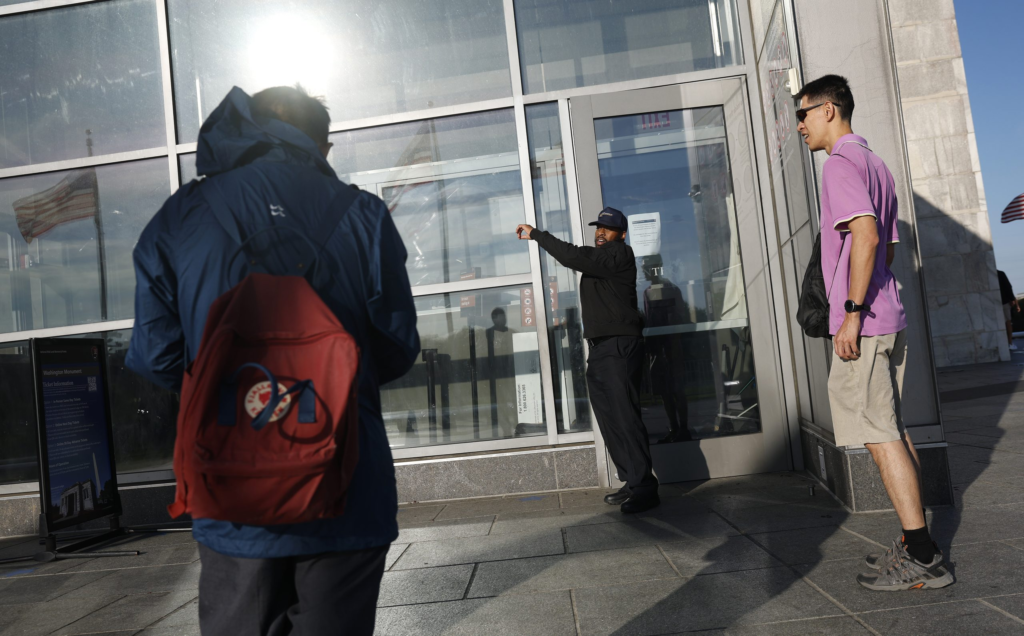
The U.S. government has officially shut down, after a deadlocked Congress failed to pass a funding measure by Wednesday’s midnight deadline.
It’s the first federal shutdown in more than six years.
Black Americans are overrepresented among federal workers and could be especially hard hit by furloughs and diminished services. Black Americans make up 13% of the total U.S. population, but nearly 20% of the federal workforce.
Prior to the shutdown taking effect, the Trump administration threatened mass layoffs of federal workers. It is unclear if it intends to follow through with that plan.
Here’s what you need to know about the shutdown.
Essential employees — think law enforcement officers and air traffic controllers — will remain on the job. Most federal workers, however, are furloughed until the impasse ends. And federal employees are not paid until lawmakers cut a deal. This situation strains the finances of people who live paycheck to paycheck.
An estimate from the nonpartisan Congressional Budget Office says that as many as 750,000 workers a day will be furloughed.
Notably, senior citizens will continue to receive their Social Security payments, since the program is considered mandatory spending and isn’t funded via short-term appropriations bills, as economists told CNN in 2023.
Medicare benefits also will continue. The U.S. Postal Service is self-funded and will continue without interruption. National parks will remain partially open.
Core safety net programs — including the Supplemental Nutrition Assistance Program and the Special Supplemental Nutrition Program for Women, Infants and Children (WIC) — will continue “subject to the availability of funding,” according to a contingency plan released by the U.S. Department of Agriculture on Tuesday.
Before a fiscal year begins, Congress is required to pass a bill to fund ongoing federal government programs and operations. That process, however, often crumbles. When it does, Congress passes a shorter-term bill — or a “continuing resolution” — to keep the government funded. Congress was negotiating a bill to keep the government funded and open beyond Sept. 30, the end of the current fiscal year.
A shutdown occurred because those negotiations failed.
Democrats have been steadfast about their demands regarding health care policy changes. Their plan would extend funding through Oct. 31. It also includes around $1 trillion for Medicaid that would come from reversing Republican cuts that were made to pay for tax reductions this year. Democrats also want to increase access to health care under the Affordable Care Act by extending certain subsidies for enrollees.
Meanwhile, Republicans haven’t been moved by Democrats’ health care demands. Republicans are saying they want an extension through Nov. 21 of the current bill — what’s known as “clean” funding because it focuses on paying for the government without any policy proposals attached — so they have more time to negotiate full-year appropriations legislation.
Black workers could be disproportionately impacted by the shutdown because they make up a large portion of the federal workforce.
In the short term, the effects of a shutdown on government services might not be noticeable to the wider public, explained Michael Neal, a senior fellow in the Housing Finance Policy Center at the Urban Institute, earlier this year. But if the government closes for several weeks or more, Americans might really start to see the impact.
When the government shutters, Black federal employees struggle more than their white peers to replace their missing income.
“In my experience, there are far fewer African Americans in the higher grades,” Cheryl Monroe, who launched her federal employment career at the Internal Revenue Service in 1987, told The Associated Press in 2019.
“White people have the more lucrative jobs in the government,” she added. “They are able to save, able to put money away for six months or a year’s worth of salary. It’s harder for Black people. We’re always starting at the bottom.”
Not only are Black workers hit the hardest, but they also don’t have “as much savings, on average, to replace their lost income,” Neal said, referring to the fact that Black households have less emergency savings than their white counterparts.
On average, white households have $8,100 in liquid assets, while Black households have $1,500, according to 2019 data. Further, fewer Black households say that they can get money from family or friends during a crisis.
Since Franklin D. Roosevelt, nearly every president has issued executive orders or enacted laws that have together expanded federal worker and contractor protections against discrimination and created affirmative action programs to boost diversity in the federal workforce and confront the country’s legacy of anti-Black racism.
Because of these efforts, Black Americans have seen “public service employment [open] up economic opportunities for good, well-paid jobs,” wrote Farah Z. Ahmad, a former senior policy analyst at the liberal think tank Center for American Progress, in a 2013 report. “The competitive pay scales of government employment have lifted generations of Black people into the middle class.”
The federal government has shut down 22 times over the course of the past half a century, and according to a USA Today review, the threat of them has become more regular over the past decade.
This greater frequency stems in part from the fact that lawmakers — especially Republican lawmakers — have embraced shutdowns as a tool for political obstruction and campaigning, as Vox’s Li Zhou explained in 2021.
Before 2013, she said, a shutdown hadn’t occurred in more than 10 years. But following the rise of the Tea Party movement during former President Barack Obama’s first term, Republican legislators used the tactic to rail against the Affordable Care Act.
“In the process, GOP lawmakers successfully made their opposition to the law clear, though they eventually caved and funding for the ACA passed. That opposition became an important part of the party’s midterm messaging in 2014, however, a year in which they successfully regained control of the Senate and kept the House,” she wrote.
Neal told Capital B that he wonders how ballooning unpredictability might affect Black workers, who’ve long seen federal employment as something of a haven from the hiring discrimination that can plague the private sector.
It used to be that a federal government job was a safe job, he explained. People gave up the really high levels of income that they could get in the private sector in exchange for the stability and better quality of life that federal employment offered.
“But if you’re starting to see greater volatility — one moment you’re working, the next you’re furloughed and not sure when your next paycheck is coming — that might make people pause,” Neal said. “They might ask if a federal government job is actually going to give them the lifestyle they’re looking for.”
This story has been updated.
At Capital B, we point to solutions, cut through confusion, and remind our communities that change is possible.
The time is right to go even further. With your support we can grow our coverage of problem-solvers, draw lessons from history, show how to drive change locally, and document success, joy, and communities helping one another.
Join us in amplifying the voices of Black changemakers. Please make a tax-deductible donation of any size to Capital B and help us continue to inform, inspire and empower our communities.
—Lauren Williams, Co-founder & CEO
Your donation will make an immediate difference.
Brandon Tensley is Capital B's national politics reporter. More by Brandon Tensley
Capital B is a Black-led, nonprofit local and national news organization reporting for Black communities across the country.
About The Author










More Stories
Does Hard Work Pay Off for Black Americans? – LEVEL Man
Trump escalates his racist attacks on Black Americans – Yahoo
A $200 million endowment focused on Black Americans is taking shape – AP News