
The Black Wall Street Times
"Access is the New Civil Right"
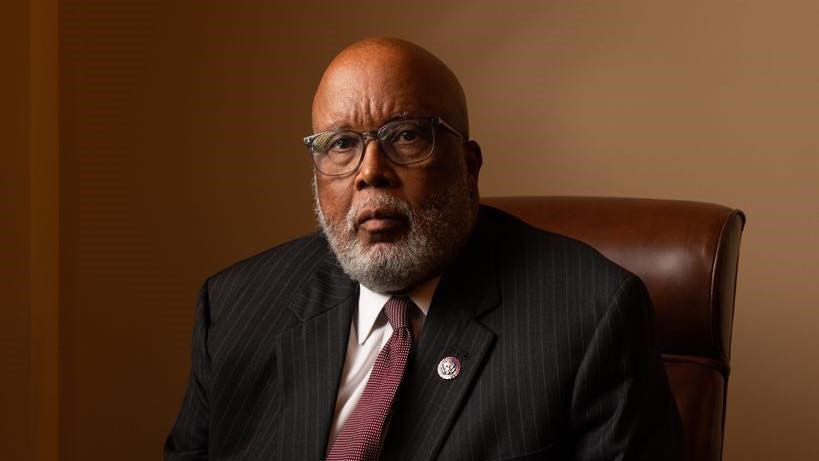
Amid a spike in racial division, democratic backsliding, and a resurgent wave of racialized political power, I sat down with the man America turns to when it needs moral clarity—United States Congressman Bennie Thompson. What he offered was not simply an interview. It was a blueprint. A warning. A balm. And, most importantly, a charge to a nation drifting toward a future it may not fully understand.
This story matters right now because America is once again choosing who it wants to be. And in that choice, Black Americans—our voices, our votes, our safety, our citizenship—are at the center of the storm.
Thompson began not with policy, but with place—Bolton, Mississippi, his hometown of roughly 500 people. It is the kind of Southern community that raised generations on faith, sacrifice, and the unspoken rule that you take care of your neighbor because one day you will need them to take care of you.
“This little town is my safe haven from all the bad folk and all the evils of the world,” he told me. “Whatever I am, it’s because of what this town exposed me to.”
At Asbury United Methodist Church, men once stood guard to keep the Ku Klux Klan from burning down a Head Start center. At a segregated school nearby, teachers told Black children, “If I can get it in your head, they can’t take it from you.” Those lessons shaped Thompson’s worldview in a community that understood danger but believed fiercely in dignity.
Those experiences shaped the man who would one day lead the January 6th Committee and become the conscience of a nation in peril.
I asked the congressman how he maintains courage when the political winds turn so violently against justice.
“What you’re seeing right now,” he said, “is what happens when people take democracy for granted.”
We have lived through an era where assumptions replaced vigilance. Progress became a soft cushion. Rights felt permanent. Democracy collapses not when evil grows strong, but when good people grow quiet.
Thompson did not attack individuals. His lived-experience is evidence of what happens when power goes unchecked. Gerrymandering. Intimidation. Suppression. Violence. Throughout his life, he has seen it all—past and present. The modern wave of book bans, voter purges, election seizures, and attacks on Black-majority cities mirrors the tactics he fought in Mississippi in the 1960s and 1970s. The only difference is scale.
When I asked about the redistricting battles raging across the country, Thompson became even more direct. He recalled filing lawsuits against Hinds County, Mississippi—fighting maps that diluted Black voting strength even when African Americans made up the majority.
“Fifty-one beats forty-nine any day,” he said. “But if you don’t fight? They’ll draw you out of your own democracy.”
Across the United States, similar strategies are reemerging. State legislatures are carving apart Black communities, stripping political power precinct by precinct.
Thompson’s warning was unmistakable: we are reliving a page of history we once believed would never be reopened. Voter suppression today is more sophisticated than literacy tests, but no less dangerous. And yes—he believes we can still win.
This was the moment when Thompson’s voice sharpened—not in anger but in urgency. “You can’t disengage,” he said. “We have to organize, inform, and educate people… and we have to remind folks what’s at stake.” He pointed to the recent No Kings protests, where thousands of ordinary Americans—many young, many new to political action—took to the streets to reject authoritarianism.
“They weren’t activists,” he said. “They were citizens who just didn’t like what they saw.” Hope, he insisted, is not sentimental. It is strategic.
We often talk about the civil rights movement as something behind us—photographs, documentaries, anniversaries.
Thompson rejects that entirely. We are living in the movement right now. It unfolds through the fight for fair maps, the battle for truthful education, and the struggle to resist state takeovers of majority-Black cities. It is present in every effort to defend multiracial democracy from those determined to erode it.
The tools have changed, but the mission remains the same: to ensure America becomes the country it claims to be.
Thompson’s blueprint for this moment is simple and disciplined:
We must organize and stay organized, voting in every election—local, state, and federal—because attacks on democracy do not take years off. We must protect one another and fight with principle rather than bitterness, refusing to let anger cloud purpose. And nothing, he warned, is more dangerous than mistaking comfort for progress.
The work continues not because we are losing, but because our presence in democracy is too powerful to abandon.
As our conversation ended, one truth became clear: Thompson is not merely reflecting on history. He is handing us a torch.
Hope, he told me without saying it directly, is not naïve. Hope is work. Hope is strategy. Hope is survival. Hope is power.
America may be drifting, but Black America is rising—steadier, wiser, and more essential than ever. And the fight ahead is not simply about resisting darkness. It is about insisting on the light.
Dr. Bridgeforth enjoys writing as a political columnist who is a passionate advocate for justice and equality whose academic journey reflects a profound commitment to these ideals. With a bachelor’s… More by James S. Bridgeforth, Ph.D.
Sign in by entering the code we sent to , or clicking the magic link in the email.
Privacy Policy.
Get the best of The Black Wall Street Times directly in your email inbox.
Sending to:
About The Author







More Stories
New York City Monuments of Black Americans: A History and Guide – New York Almanack
'They know a scam better than anybody': Trump makes off-the-cuff remarks about Black people while defending 'garbage' insults – TheGrio
Inside the life story of America’s first black woman on the Supreme Court – Daily Nation