

Published 6:49 am Saturday, August 30, 2025
By Jim Beam
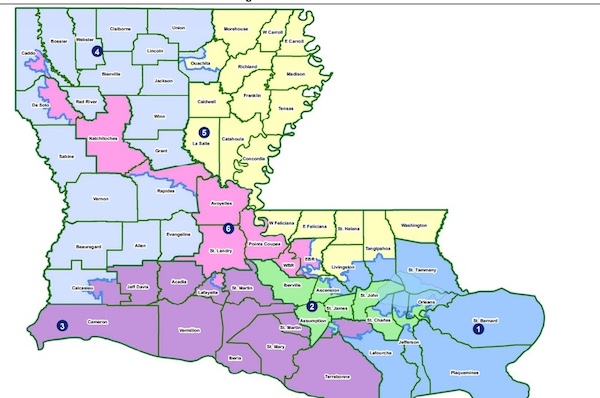
A federal district court in 2024 ordered the Louisiana Legislature to redraw its congressional election map to provide for two Black-majority districts. The state did that and decided to defend the map before the U.S. Supreme Court, but Louisiana Attorney General Liz Murrill has had a change of heart.
The Advocate reported Thursday that Louisiana is now urging the nation’s highest court to issue a ruling that would throw out that congressional map. If the court does what Murrill is asking, it’s possible Louisiana could lose both of those minority districts, but it would definitely lose one.
U.S. Rep. Troy Carter, D-New Orleans, has represented the state’s 2nd Congressional District since 2021. U.S. Rep. Cleo Fields, D-Baton Rouge, was elected in 2024 to represent the 6th Congressional District, which is the state’s second Black-majority district that was created in 2024.
State officials in 2024 said the new Louisiana congressional map was created for political reasons — to protect the Republican seats of U.S. House Speaker Mike Johnson of the 4th Congressional District and U.S. Rep. Julia Letlow of the 5th Congressional District. If one district had been created in north Louisiana, one of them could have lost their seat.
A group of “non-African Americans” filed a lawsuit claiming Louisiana’s Black population doesn’t live close enough together to support creating two Black-majority districts. The district stretches from Baton Rouge to Lafayette to Shreveport. Murrill now says and agrees the map violates the U.S. Constitution.
Why the change of heart?
Ashley Shelton, leader of the Power Coalition, a New Orleans-based community activist group, answered that question.
“What changed? Other than the political whims of the president (Donald Trump),” Shelton said.
Shelton is talking about Trump asking Texas to create five new Republican congressional districts to help Republicans hold onto control of the U.S. House of Representatives at the 2026 midterm congressional elections, which is always difficult for the party in power.
You can be sure that Murrill’s change of heart was motivated by Louisiana’s Republican Gov. Jeff Landry for whom she worked when Landry was state attorney general and who does all of Trump’s bidding.
California’s Democratic Gov. Gavin Newsom decided to counter the Texas effort by creating five new Democratic congressional districts in his state.
The U.S. Supreme Court has consistently held up a decision on Louisiana’s creation of two Black-majority districts. However, it will hear arguments on the state’s case Oct. 15.
State Solicitor General Benjamin Aguinaga will argue before the court that the law creating two Black-majority districts became law because of “unprecedented pressure by the courts to draw a second minority-majority district or the courts would (do it) …”
If the Supreme Court accepts Louisiana’s argument, election observers say it would mean drastic changes to how election maps across America are drawn.
Michael Li, a redistricting authority with the Brennan Center for Justice, which is affiliated with New York University Law School, said, “It’s (the Louisiana argument) a breathtaking wholesale attack on the Voting Rights Act, which just turned 60 this month.”
“It’s also completely unfounded,” Li said, arguing that for four decades the courts were able to distinguish between situations where Black-minority districts are necessary to remedy race discrimination and where they are not necessary.
The Advocate said the high court has asked for new arguments on whether Section 2, the remaining legal tool to enforce the Voting Rights Act, violates the 14th and 15th amendments to the U.S. Constitution.
Murrill now argues that requiring state legislatures to draw maps that sort voters by race does force states to violate the federal Constitution.
The Advocate last Sunday said legal scholars think the 6-3 conservative majority on the Supreme Court might be ready to set aside “one of the last major civil rights protections from the 1960s” — the Voting Rights Act.
The argument is that race relations are generally better and the law is no longer needed. Unfortunately, that isn’t the case in Louisiana and in other states that have resisted creating new Black congressional districts for many years.
The Voting Rights Act was passed because Black Americans had been denied the right to vote for much too long. Now — depending on what it decides — the Supreme Court may once again deny Blacks the representation they deserve.
Jim Beam, the retired editor of the American Press, has covered people and politics for more than six decades. Contact him at jim.beam.press@gmail.com.
About The Author









More Stories
A $200 million endowment focused on Black Americans is taking shape – AP News
Henry Louis Gates Jr. Explores the Connection and Conflict Between Black and Jewish Americans: ‘A Formidable Force' – People.com
Why Hard Work Doesn’t Pay Off for Black Americans – Medium